Tuesday, April 19, 2016

Blog #15 Au Revoir Millbrook High School

I was a girl with braces and contacts and two older brothers that lived at home who thought hospitals were cool when I entered Millbrook High School. I was scared that I would get lost on the "huge" campus.  I was without any stamps in my passport. I was worried about leaving my friends behind. I was confident I would be best friends with my then current best friend for life. I was sure I would not date until college and that I would certainly only date with the intention of marriage. I was confident I would become a better person through high school.

I am now heading out without braces and with glasses. I am the only child at home and I don't really want to leave. I am someone who absolutely loves hospitals and basically wants to live in one. I am not scared of the campus that actually is pretty small at Millbrook. I am ready to get used to the ECU campus. I am carrying a passport with a few stamps and I have a plan to get some more. I am not worried about leaving my friends as I know I can still be there for them. I am not best friends with my middle school best friend. I am someone who learned from dating in high school and know the pros and cons of dating someone for short term. I am sure I have become somewhat of a better person through my experience in high school.

I will be someone who continues to learn throughout my whole life. I will be someone who continues to work my hardest. I will be someone who appreciates literature and puns :P even though that hasn't changed through high school. I will be someone who like Whitman can truly say "I am large. I contain multitudes". I will be open minded. I will not allow a title to define who I am. I will not be a stereotypical American / first world country citizen and think of only myself. I will devote my life to service. Oh and I will succeed :)

P.S. If you are reading this for posting comments... Here are some funny memes that will give you some good advice!

DONT SKIP CLASSES CHILDREN

CHOOSE YOUR FRIENDS WISELY

BE CONFIDENT IN YOOOOSELF

DON'T TAKE LIFE TOO SERIOUSLY 


Friday, April 8, 2016

Whitman, Walt Whitman

Whitman's Notebook 
I could make out about every 3rd word. I also think the first page is like a contact book with addresses. He clearly wrote ideas about what to write including plot ideas and themes such as "two characters as of a dialogue between A. Lincoln (?) and W. Whitman (?)" with the theme of "lessons for a president elect". Other words that I could make out include "philosophy", "shall", "crash".... I think it is interesting that there is a stamp in his notebook. I think that his notebook and my dad's look similar, both are difficult to read and hard to follow but completely understandable to the writer of them. Um wow the drawings are awesome. I really like the hats clearly channeling Mr. Abe. And then maybe a harp. And the creepy skeleton one. I think that it is significant that instead of some authors who just randomly start writing it seems like he planned everything out a bit. I wonder if these notes he wrote late at night like I do. I have a notepad by my bed and I jot down the things I remember or think about as I am about to fall asleep. His writing it certainly messy enough (no hate). I think something else significant is that he crossed things out as his ideas for poems morphed and changed.

Whitman's Notebook 2.0 
Wow! These notes are really helpful! I was write about the contact info but it is quite sad that the contact info he wrote was for one of his friends who soon died. I think it is signifiant that instead of tearing that page out or scribbling out his friends info which would remind Whitman of his loss. Maybe he kept it so that he could have a reminder of his friend. I like to think that, this is the reason, and that Whitman was a sentimental guy. Yay thank you smart people for explaining the stamp. Whitman didn't like the disunity of his country. I agree that his tone changes not only in his poems but also in his notebook. He uses a lot of imagery specifically regarding color like black. Finally, I agree that the last page is the most mysterious because not only is the drawing hard to understand (is it a rising or setting sun) and then also what the drawing represents. It is relevant that some of his work is not understandable as he wrote it for himself and not him.

Friday, March 18, 2016

Sweet dreams are made of .... 'MERICA!

American Dream 
As according to Jenna McMains
Having the opportunity to achieve any goals that you set out with the assistance of a supportive community which leads to a feeling of satisfaction while remaining both physically and emotionally healthy.

Wealth 
As according to Jenna McMains
Either tangible or intangible possessions of either material or emotional value.

American attitudes toward wealth and poverty {and my own}
As according to Jenna McMains
Americans value wealth immensely and the most common form that they value is material and monetary wealth. Americans relate poverty to not only a lack of wealth but also a lack of opportunities and intelligence. Americans associate wealth directly and proportionally with wealth. The context of these Americans is that they have only known wealth as compared to the world. For example, I want to become a surgeon {a career that affords you a nice salary} but I want to spend the majority of my life involved with doctors without borders {which doesn't exactly pay at all}. The majority of Americans both old and young thing I am crazy and that soon I will grow up and lose that dream. That I will decide to keep a real job and not waste my {hopefully future} talents. It is a common belief that happiness and wealth go hand in hand. For my travels I have learned that this is not necessarily true. I have seen children and families with so much less materialistic wealth than Americans but just the same amount of happiness or even more. I don't really care if I end up wealthy or poor but I do care that I use my life to help others. Now maybe I will smarten up and become stingier with the time I choose to donate but I can't see that happening any time soon. I believe that I have the American Dream because I have the chance to be or do almost anything that I want. I also have the support of my parents, teachers, and many community members. But, many believe that the word "dream" connotates passive words and actions such as sleeping, daydreaming, thinking but I think the opposite. I have worked towards my dream. I have studied at school, participated in events, joined clubs, and spent way too much thinking and planning and working towards my American Dream. My American Dream is not a passive one it is highly active. This is because not only of my innate beliefs but also because of my learned beliefs. My context and environment has taught me to work for what I want and to have perseverance.


Friday, March 4, 2016

Translations {the good, the bad, and the punny}

#1:As Gregor Samsa awoke one morning from uneasy dreams he found himself transformed in his bed into a gigantic insect. 
Diction: "uneasy" - less negative, "bed" - personal, "gigantic" - more extreme and abnormal
Syntax: No commas, exclamation marks, or other abnormal punctuation. Not much emotion.
Imagery: Location is given. Gigantic = abnormal. So you can image him as a bug awkwardly larger than his bed.
Structure: Being a bug interrupted him waking up from dreams.

#2:Gregory Samsa woke from uneasy dreams one morning to find himself changed into a giant bug. 
Diction: "uneasy" - again less negative, "changed" - implies can be reversed, "giant" - less dramatic
Syntax: Again no punctuation. Seems like a factual sentence because of a lack of commas.
Imagery: I imagine him just in his room or outside of his house not in his bed.
Structure: Again the main part is that he woke up with the caveat of being a bug.

#3:When Gregor Samsa awoke from troubled dreams one morning he found he had been transformed in his bed into an enormous bug. 
Diction: "troubled" - more negative, "found" - past tense shows narrator's POV clearly "enormous" - more extreme and grotesque even
Syntax: Again no punctuation :( But there is a lack of a comma. It could go in between "morning" and "he" or at least that is where I feel a natural pause is.
Imagery: Both troubled and enormous are more extreme words that make me picture that he was having bad nightmares and then woke up to an even worse reality.
Structure: I feel like the focus is more on the transformation than waking up which adds more drama. This translator is a drama llama.

#4:One morning, upon awakening from agitated dreams, Gregor Samsa found himself, in his bed, transformed into a monstrous vermin.
Diction: "agitated" - more clinical and reminds me of nature, "monstrous" - scary!, "vermin" - ew
Syntax: Commmmmmmas! I'm so happy. Makes the sentence way more stretched out.
Imagery: Much more negative. I imagine him thrashing around in his bed and then waking up totally freaked out, scared, and screaming.
Structure: The transformation interrupts the waking up which interrupts the morning.

    Word choice, syntax, punctuation, and imagery are very important in creating the proper EFFECT {my new favorite Written Task word} in the reader. I believe that word choice is the most important factor for translators to consider when translating texts. I believe this because the first thing that readers notice when reading is what they comprehend. They instantaneously try to understand what the sentence means. Each reader has specific preconceived notions regarding the connotations of word choice. This means that as the reader reads the translated text they will get a very strong first impression due to the word choice. While not all readers can be appeased with the use of proper word choice. The translation can be analyzed to make sure the connotations are correct. Certain nuances within languages and synonyms can lead to very different perceptions of texts.
    I believe that the second most important factor in translations leading to correct interpretations is syntax and structure. The order of words relates to the importance of themes represented. Also it can create certain emotions such as shock, acceptance, or jubilance. If the author chooses to include the commentary before the fact then the reader might agree more with the commentary while if the fact is presented first then the reader has time to formulate their own opinion. Syntax also heavily impacts the tone of the text as the reader can choose to order the sentence in such a way that the tone is matter-of-fact versus dramatic.
    I believe that punctuation and imagery are of equal importance. Punctuation lends itself heavily to the creation of the tone of the text. Imagery does as well. The addition of commas or descriptive words can elongate a section and further clarify the emotions that the authors wants the reader to infer. Also punctuation such as exclamation marks and question marks can truly impact the interpretation of the text. Similar to word choice, imagery can also be geographically or culturally specific a certain descriptive nouns and adjectives.
     This exercise brings up many questions and considerations regarding translations and the impact of incorrect words, structure, or punctuation can have on the reader's understanding of the text. The tone between translations can differ immensely. I have learned through the analysis of these multiple translations of Metamorphosis and The Stranger that specific translations can truly change the intended impact of the entire story. I believe that there should be some regulatory group that makes translators meet and discuss their reasoning of specific word choice, syntax, punctuation, and imagery. This way a consensus can be reached or at least a more cohesive and understandable translation can be reached. This way no matter what translation students and readers view they will get the same intended effect.

TRUE LIFE! Punctuation really matters folks! 


Disclaimer: So I spent way to long finding puns. Here are my favorites.


I was going to include more but I felt as though it would take up to much of my precious readers {fellow IB CULT members'... ermmmmmm students' time}. 


Sunday, February 21, 2016

Practice {IOC} makes Perfect {IOC}

I uploaded my practice to Youtube with the audio and the image is of my passage and my planning :)


Self- Score 
Criteria A -9 
I think that I show very good knowledge and understanding of the novel and the context of the novel. I think that the context explained both of the book to when it was created and the passage to the novel as a whole makes the IOC understandable for people who even have not read the novel. The two themes I chose to highlight are backed up by quotes from the passage and the literary features highlighted in the IOC are backed up by at least one direct quote. Each quote is explained and connected to a literary feature and thus a theme and the overall effect on the reader.

Criteria B -8
I think that I showed good awareness of 3 main literary features that Ishiguro uses throughout the book. I explained how each quote was an example of a feature which had 1 of 2 main meanings which then had an effect on the reader. I showed how the context of the book made the meaning have a greater effect on the reader. I could have explained more in depth about the effect on reader but ran out of time. :(

Criteria C -5 
I think that my IOC was very organized. I had a clear thesis. I then gave clear background information and context on both the book and the specific passage. I then gave clear examples and explained how they supported my thesis. I then ended my IOC with a conclusion relating back to thesis and connecting again to big picture and context.

Criteria D -5 
I believe that I used clear and appropriate language. I used the diction of the book when referring back to it. I considered the connotations of words that I used in an effort to have a clear meaning. Despite a few "umms" my grammar was correct. My vocabulary, sentence structure, and terminology are all appropriate and effective in communicating my thesis and examples.

Sunday, January 31, 2016

Judging books by their covers

Image Basics
Image Similarities 

Intended Purposes
Cover 1: The cover implies that the book is about a sad/ melancholy European or American girl in the country who seeks or finds herself in solace. 
Cover 2: The cover implies that the book is about a child who is perhaps fleeing because of the blurry image. The child could also have just "let go" of someone's hand. The cover focuses on the author's name and perhaps will cause the viewer to infer that the child is Asian. 
Cover 3: The cover implies that the book is sad and about loneliness. The cover plays off the fact that if the pole "let go" of the boat it would drift away which is negatively connoted.
Cover 4: The cover is the most creepy because of the childish drawing of internal organs in a body of barbed wire implying capture. Additionally the drawing is taped to a window that shows a forest implying solace. The spooky handwriting draws attention. 

 vs. 
Cover 1 conjures the words "lonely", "hidden", "not modern". Quite honestly I think of a Taylor Swift song where she is sad because some guy dumped her and she is forever alone. Cover 2 makes me think of the words "running", "child", and "dream". I think that the child is running from the photographer because they are scared, mad, or unhappy.

Cover 1 if I saw it before I read NLMG would make me think the book is about a lonely girl in rural Europe or America. Because I have read the book the image represents Kathy H. at Hailsham. Cover 2 before reading would make me think that the book is about a child who is unhappy. Because I have read the book the image represents children who are donors running from the scary adult world of responsibilities.

Cover 1 is portraying Kathy H. from perhaps the perspective of Tommy or Ruth. Cover 2 is portraying any child (girl or boy) that is a clone. The perspective is perhaps from an adult or guardian.

Cover 1 places the book in a Westernized cultural setting. The teenage girl appears to have no makeup on and non revealing clothing thus implying innocence. Cover 2 places a focus on the author's name. This might make the author think that the dark haired child is of an Asian ethnicity or set in a country within Asia. The child's hair is short enough to be "boyish" but long enough to possibly be the hair of a young girl. The construct of independence is represented because the child is running away without help.

Cover 1 was perhaps made by a British company. As you can see in the map below a high percentage of people in the United Kingdom. The cover plays off the archetype of "innocent maiden" female characters because the young women is modestly dressed and submissive in posture. Cover 2 was perhaps made by a more globally oriented company. Approximately 75% of people in the world have dark brown or black hair. Using a child with this hair color would allow there to be a greater chance that the reader connects the child pictured with himself/herself or a family member. Additionally, it is not clear if the child is a boy or girl which would connect to all readers because females can think the child is a girl while males can think that the child is a boy.


Tuesday, January 19, 2016

TED Talk | Story Telling

-----------------------------------------------------------------------
http://49.media.tumblr.com/043d4378d4b513020dd85d124e370cc9/tumblr_mq3k4c4f7J1qz8x31o1_500.gif
Twitter has become essential to people's lives and is a mechanism of broadcasting. 
http://49.media.tumblr.com/ab6126cde0e87f0872b67d6bb65982b6/tumblr_mq3k4c4f7J1qz8x31o2_500.gif
  Fitzgerald's main point is that new mediums create new formats of story telling which create new and evolved stories. Twitter and the Internet are both new mediums that connect many authors to many readers. Twitter is now being used as both a distribution medium but also a production medium. Short stories are split into tweets that are serialized where audiences can tune in daily at a certain time. This builds suspense because the reader no longer controls the speed of reading. Through Twitter there are parody accounts with fictional characters engaging in the real world providing a social commentary as well as non fiction real time story telling from historical accounts (eg. on this day 60 years ago...). Some historical examples of new mediums creating new stories is short stories in the digital marketplace becoming longer and longer because of reader requests. The digital format allowed for a quick feedback system. Also radio evolved from broadcasting reading of books to broadcasting live play of a story in a serialized manner. 

  Fitzgerald's purpose is to prove that new mediums (specifically Twitter) are creating new formats and new stories. He uses ethos when he begins the presentation "in my job at Twitter..." by showing that he is employed by Twitter he is thus knowledgeable on what users utilize Twitter for. He uses logos when he uses specific authors names and their Twitter accounts to prove his point. He is biased to believe that Twitter is revolutionary and impacts all users. The authors and accounts he mentions include Hugh Howey, Jennifer Egan, The New Yorker, Elliot Holt, West Wing, Mayor Emanuel- parody account, Dan Sinker, Crimer Show, RealTimeWWII, and Teju Cole. Fitzgerald uses pathos when he uses leading words. For example, when referring to the account RealTimeWWII he says: "you're beginning to see ways in which people are telling stories with nonfiction content that can be built into new types of fictional storytelling." Particularly, the word "new" is very leading because similar formats have been published such as in daily newspapers or emails having a "on this day in history" section. The word: "new" causes an emotional excited reaction in readers as they feel an advancement has been made but it is possible that the reality of the newness of the idea is not truly accurate. Fitzgerald kept most of his words scientific in nature which helped to build ethos but some leading words can still be found. 

  I chose this TED Talk because I am interested in the use of social media. I use social media to spread information pertaining to Millbrook and DECA events. I also have researched using social media to advertise to users. I was very interested to see how writers have creatively used Twitter to tell fictional stories. Using evolving mediums to tell stories is something very important to consider as it possibly (as Fitzgerald says) will impact the plot and message of the stories themselves. This relates to last year's theme of mass media. Author's change how they write and what they write if there is instant feedback from the audience. Author's may change their message to appease their audience if they get negative feedback and need to "boost" ratings.  

http://49.media.tumblr.com/c0fc717c30b5afc630ab7d661d4ade93/tumblr_mihjdjosWE1qz8x31o1_500.gif
This GIF is just an example of the use of Twitter to get instant feedback. Even it is from yourself :P

Thursday, January 7, 2016

Scandalous Stanwyck

5. How is Barbara Stanwyck’s character portrayed in this film? What type of angles is she shot in? What type of lighting surrounds her? Is she a good, likeable, moral person? How does she interact with and treat Fred MacMurray’s character? What does this tell you about the way that women were viewed in the 1940s?

Good ol' Barb's character is portrayed as very sensual as in the first shots of her she is in only a towel. Additionally she is seen fixing her hair and makeup propagating the stereotype that women care significantly {and primarily} on their looks. Another situation to consider is the initial conversation between Stanwyck and MacMurray's characters. In this scene Stanwwyck is sitting or should I say "sexy" slouching {if that is a thing}. A notable part of this scene is that Stanwyck's ankle is highlighted. While nowadays it takes a lot to be consider scandalous apparently in those days all it took was a glance downward to the ankles. {Apparently, the 1940s to ankles is the 2010s to shoulders}. Finally it should be noted that there is a focus especially with the camera angles on her legs and their {magical} existence below the hemline of her dress.

Stanwyck's character is shot in many close and tight angles. Her outfit, face, hair, and legs {as previously mentioned} are highlighted. It is well known that is film was low budget which is reasoning for many of the tight shots but the producers and directors still chose to have these shots of not just Stanwyck's face and mouth {when it was moving}. The lighting that surrounds her is very stark. Her face {or legs} are very bright and the background is dark. She is portrayed not only through movements and camera angles but also through her verbal actions as sultry and troublesome. Throughout the film Stanwyck and MacMurray's characters banter. While on first glance showing Stanwyck's character talking might seem like a win for 1940s feminists it actually is not because she is shown as heartless. Phyllis appears to have no morals as she is proponent of adultery, murder, and well she is plain greedy and manipulative. Additionally all the men in her life end up in major trouble {dead, collapsed} as she does herself.

Although sometimes the curtain is blue just for the sake of being blue {see image below - apology for the curse word} it is interesting that Walter is the one who is able to overcome emotion and kill his S.O. This shows a transition in Phyllis from heartless to a emotional position where {as the kids say it} she is hit in the feels. Is should be noted that Phyllis does previously admit to Walter that she never loved him and in the words of Shakespeare "The lady doth protest too much". So maybe all her talk was simply that, talk, and she really did love Walter. Stanwyck's character's portrayal in the film is very indicative of the social situation of women in the 1940s. In the 1940s World War II was in full swing for the first half of the century. While this meant that women got more jobs out in the workforce and some even went to war there was still a movement of conservatism. The majority opinion was though in favor of working women since the economy depended on it. Women were encouraged to be masculine and help their countries by getting a job outside the home so it is no coincidence that Phyllis' scheming and power {money} hungry mind was showcased. This high level thinking was indicative of a man but a woman was having these thoughts instead {who would have though it}. You can definitely argue that Double Indemnity is more chauvinistic with the required help of a man and Phyllis' reliance on men but I believe {hope} that it was slightly feministic in nature.


{A review of my discussion in photos}


While Double Indemnity isn't a family film. I certainly saw more of Stanwyck's bare skin than MacMurrays.
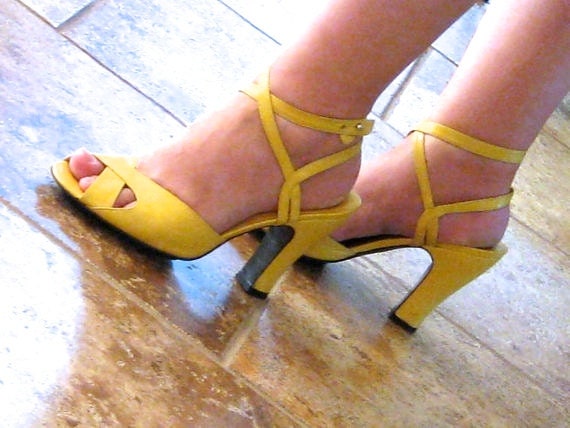
Woah! Look at those shoes highlighting her ankles {scandy}. 
Hmmm. 1940s : ankles = 2010s : shoulders.
This is "why" women should care about their aesthetic {like Stanwyck's character}.
NOTE THE DRUNK MISSPELLING OF ANGEL! 
In Double Indemnity it appears as if Phyllis heartlessness makes her more appealing to Walter.
{Preach T-Swizzle}
Because women are creatures guided by only harsh and cruel emotions.


Excuse the language but sometimes teachers {AND IB STUDENTS} are like this when analyzing.

Those feelings sure hit Phyllis because she was a woman.
{Note: this is a crash course JOHN/HANK GREEN episode <3}
Rosie the Riveter was released two short years before Double Indemnity was released.
Women were prided for their strength and "manly" qualities such as scheming {perhaps}.

Found that feminism ;)

Friday, December 4, 2015

Netflix and NO Chill {Macbeth Style}


1. How to Get Away with Murder
Macbeth would watch Viola Davis star in the highly acclaimed series centering around murder, guilt, and drama. Macbeth after committing more than one violent act on his own would watch HTGAWM in order to ease his guilt conscious and to get tips about how to deal with guilt. Also he is a fan of Shonda Rhimes because she gives him the major feels and as well as know Macbeth is highly emotional.

2. Gossip Girl
While you might not originally think Macbeth would watch such a girly show, think again cause he sure would. Macbeth {before he becomes a murderer} is quite in touch with his feminine side. He also relates strongly to the female centric plot of Gossip Girl where women manipulate, convince, and connive in order to gain more and more power.

3. Person of Interest
Although Person of Interest is a very modern and current show focusing on the power of technology to act as a big brother. But Macbeth finds solace in watching a show that has a similar level of paranoia as he does. POIs paranoia focuses on a God-like machine while Macbeth worries about the witches' prophecies and being dethroned.

4. Alias
Macbeth other than just adoring Jennifer Garner loves the premise of Alias with it's focus on the supernatural and corrupt leadership. He most identifies with the antagonist Arvin Sloane as Arvin kills anyone who gets in his way to achieving power. Additionally Arvin believes that killing his opponent's family {Jack Bristow} is definitely okay which makes Macbeth feel less guilty about the fate of Macduff. Also Alias relates to the premise that Macbeth is surrounded in of two sides and masks {Fair is foul and foul is fair}.

Monday, November 2, 2015

Blog 5: Swords + Epic Poems


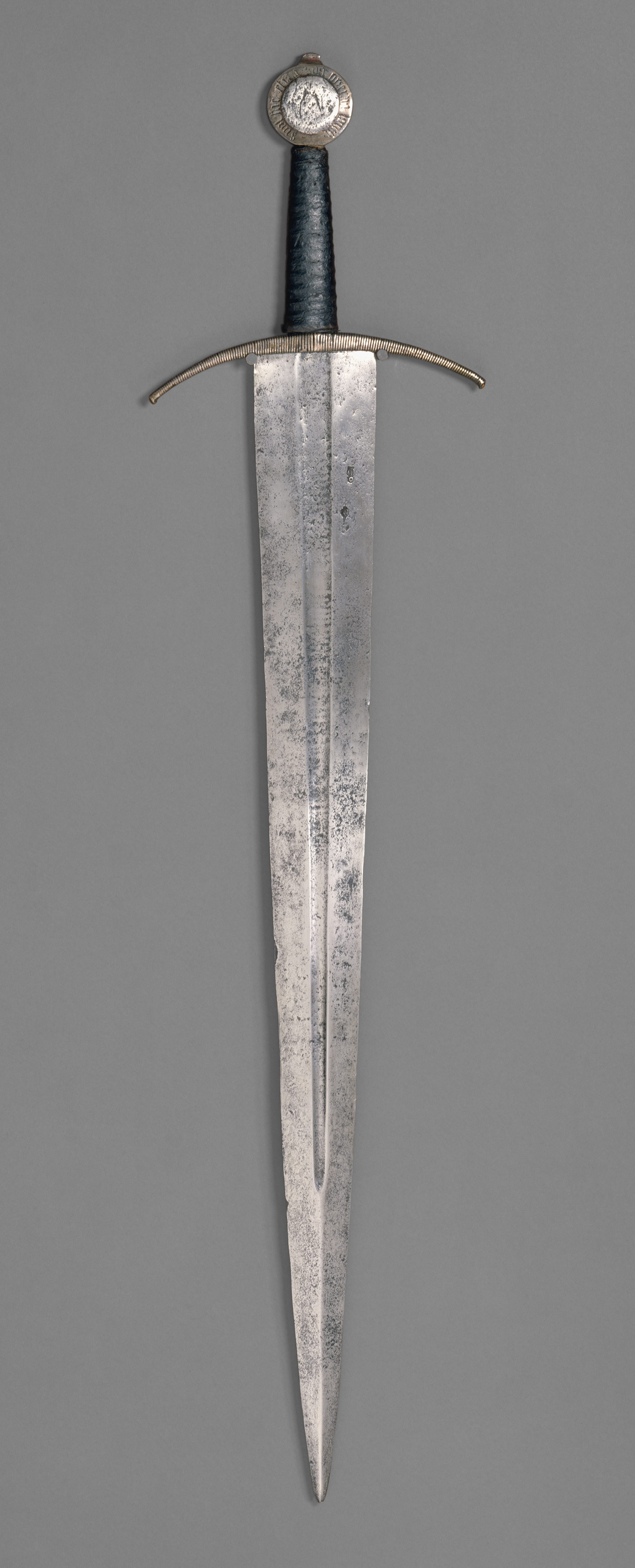
No known artist (creator) - Western European 
Sword 
ca. 1400 
Steel, silver, copper, leather 
102.3 cm in length 

This sword was created in Great Britain / Ireland (more broadly known as Western Europe) in about 1400 AD. The culture surrounding this piece relates to values placed on being a chivalrous, valiant, sword wielding knight. 

The sword has the words (in Latin) "Here, too, virtue has its due reward", which is a line from the epic poem Aeneid about a warrior who became the ancestor of the Romans. The use of copper for the cross guard implies that it was for ceremonial not battle usage. The sword represents the profession of a knight as they were who would use swords and be awarded them ceremoniously. The poem line inscribed is meant to remind the knight who was give the sword that virtue is important. Perhaps this sword along with public recognition and probably a gift of land, was a reward for the knight's virtue on the battle field. This could possibly be considered a new treatment of the traditional theme of ceremonial swords. Often times symbols would be inscribed as oppose to words because some knights were not literate. The creator chose to inscribe words (in Latin) because he/ she believed that the recipient would be able to read them and understand their significance in relation to the Knight's own actions. 

The artist uses shape in order to look similar to swords of the time period as a ceremonial sword should be recognizably at that time modern. The art is organized to look like a regular sword with a bit of decoration. Knights while respected were not the highest social group and thus did not have the nicest swords or weapons. The relatively novel technique of using acid to inscribe the poetry enhances the meaning that this was a ceremonial gift and type of reward. Whoever commissioned this sword to be created wanted it be one of a kind and mean something to the recipient. 

The purpose of the work is to show the value of chivalrous knight-like behavior. The clues are mainly in the inscription being in Latin, being made using acid, and the usage of copper. Some implied themes include the value placed on specific (chivalrous) behaviors and the value (in a community) of a knight. The creator of this sword (as previously stated both the commissioner and the actual creator are being analyzed) aligned with pre-existing similar ideas regarding that virtue and chivalry is very important and that knights are valued (not most, but still a large amount). The title is Sword and thus is named by probably the museum so the title does not have any real significance. It is notable that the sword was regular enough to not garner a special name (Excalibur). The sword still signifies similar beliefs at the time it was created and now. In today's society the value of the art is mainly historical since it is one of the first instances of acid inscribing and the words regarding virtue from Aeneid are still significant as the epic is regarded as a important and telling work of literature. 

http://www.metmuseum.org/toah/works-of-art/32.75.225

Tuesday, October 20, 2015

Blog 4: Canterbury Tale's Rural Academy Theatre Performance

I was at the performance and thus don't have to write a blog :)
Thanks @ Mrs. Genesky for giving us this opportunity!

Tuesday, October 6, 2015

Blog 3: Bed and Breakfast | Sloth and Gluttony

First off Blogger deleted my original version of this blog and I was unable to retrieve it so this blog is definitely going to be WAY less quality as I am trying to remember what I wrote before (oh and ya I did think it was my best blog entry... EVER). okay apologies. My rant is finished. 

This advertisement was created by Volker Schrader in Germany in July 2012. 

The advertisement is of mattresses | pillows | blankets arranged to look like toast with bacon and a soft boiled egg. The writing is very minimalistic in order to not draw attention away from the image. On a shallow level the audience will think the advertisement is cool as they probably thought it was real food at first and will admire the technique of the artist.

On a deeper level the advertisement relates to two of the deadly sins: sloth | gluttony. Sloth is defined as reluctance to work or make an effort. What is a better example of sloth than lying around in bed all day? Gluttony is defined as habitual greed or excess in eating. Eating a huge breakfast that you have been thinking about since you booked your vacation seems like a very good example of gluttony. 

The intended audience of the advertisement is middle class or wealthier citizens in anywhere that toast is a seemingly normal breakfast food (Europe and the U.S. to just name two). The audience is most likely middle class or wealthier because they are okay with spending money on a vacation. This advertisement is usable in a wide range of locations such as on a billboard, in a magazine, or on a website because it features not much about the B&B’s ideal guest (such as gender or ethnicity) which could narrow the market. The audience must have the cultural knowledge of acknowledging that bacon | eggs | toast are breakfast foods and thus this advertisement is hinting that the website is for a B&B. Schrader uses the layout of a large background image with very little text to make the advertisement look more like real food. He also uses colors that are close to accurate but not exactly in order to entice viewers to take a closer look. Honestly, it must have taken forever to find the exact shade of blanket and pillow to make a semi realistic breakfast food bed. 

Schrader deceives the audience with the breakfast food actually being bedding but other authors and artist deceive their readers and audiences with hidden biases. Schrader uses the stereotype of bacon | eggs | toast as breakfast foods in order to achieve the effect of the audience that when they look at the advertisement they instantly think of a delicious breakfast and then a good luxurious night's sleep. Additionally as mentioned before this advertisement is appealing to a wide and more diverse audience. This can be seen in mass media through either not specifying gender | ethnicity or specifying a "unique" gender | ethnicity (ie. mixed race family in cheerios' ad, or a hallmark ad featuring a domestic partnership [now most likely marriage] between two women). This type of "hip" "morally accepting" advertising can either represent the bias of the company or what the company thinks the majority of their customers' bias is.

Here are the two other images | advertisements in this set:
This breakfast assortment of eggs | sausage | spinach (?) looks definitely less normal to me (a North American)
Same as the previous image. Pickles | cheese | lettuce (?) on toast does not look appealing nor normal to this American. But I am sure that in the area that these advertisements was used [Germany (?)]. These two other images were of typical breakfasts.


Source: CreativeAdAwards.com

Saturday, September 19, 2015

Blog 2: Jenna and the Case of the Mysterious Venn Diagram


http://images.clipartpanda.com/overstatement-clipart-1.png

https://coolestfamilyontheblock.files.wordpress.com/2011/03/namemeaningcard-jenniferjenny-01.jpg

http://rlv.zcache.com/name_meaning_jennifer_tshirt-re3d86bf19ed6472bbc64c034788b2721_j2nhu_324.jpg
http://38.media.tumblr.com/53a5e909790bd7d7bddb86437c8abc6e/tumblr_n108g6RJxr1rlqu0zo9_250.gif
http://i.imgur.com/19gzriC.gif
http://images.sodahead.com/polls/003155249/3412730079_2344769612_YEAH_I_AGREE_answer_1_xlarge_answer_1_xlarge.jpeg
http://jokideo.com/wp-content/uploads/2012/05/292628_320517524688963_126894987384552_733750_1718577327_n.jpg
http://www.abetterbalance.org/web/images/stories/familiesforabb/fairness%20in%20the%20workplace%20icon%20-%20balanced%20scale.png


http://33.media.tumblr.com/759bb6cf098fbf1570c8492587e51854/tumblr_msw0sysd8a1setwdzo1_500.gif

memebuilder.com
http://www.memes.com/meme/458737

https://imgflip.com/memegenerator
http://www.egsd.net/HighSchool.cfm?subpage=1269290
https://imgflip.com/memegenerator/Chef-Gordon-Ramsay
http://cdn.meme.am/instances/500x/57609962.jpg


http://images.clipartpanda.com/overstatement-clipart-2.png
http://www.lifeleadership.com/blog/wp-content/uploads/2015/07/Helping-Others-11965733_s.jpg
http://www.katebeddow.co.uk/wp-content/uploads/2014/03/lazy-teenager.jpg

from Facebook
http://www.pinkjooz.com/wp-content/uploads/2013/07/self-centered.png
From Facebook
http://www.augustana.edu/blogs/augieblog/wp-content/uploads/2014/01/images.jpg
From Facebook
http://whyareyoustupid.com/wp-content/uploads/Funny-Sad-Man-Microwave-Starts-Making-Noises-But-Still-Cold-First-World-Problems-Meme.jpg
http://cdn.shopify.com/s/files/1/0188/4122/files/box-box-toy-cardboard-cute-robot-robots-Favim.com-103826_large.jpg?3509
http://justsomething.co/wp-content/uploads/2014/03/tweets-first-world-problems-4.jpeg
http://ak-hdl.buzzfed.com/static/enhanced/web05/2012/10/5/9/enhanced-buzz-32692-1349445559-4.jpg
http://i1.kym-cdn.com/photos/images/newsfeed/000/142/422/tumblr.jpg


Summary (with words)

My real name is Jennifer which is a cornish version of the name Guinevere which means "fair lady" and I do think that this name fits me because I try to be honest and fair. My name and use of a nickname defines me because I know in the real world (represented by substitutes who do not know me and college apps) I am legally Jennifer and that name defines me as being an adult.

The two me's that fight to co exist is the service oriented me and the self centered teenage me. I chose to make this a wordless blog because I knew I had many pictures of my trip this summer which reminds me to be self less and serve without ceasing and how that is true happiness. I am an individual who loves service but I sometimes am part of the collective selfish teenage larger whole.